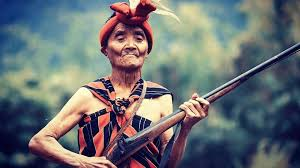
A Chin hill fighter holding a traditional handmade “Tu Mee” shotgun — a weapon that came to symbolize the early phase of Myanmar’s Spring Revolution. Credit: BBC Online.
From catapults and stones to homemade “Tu Mee” shotguns — how the Chin highlands ignited a new phase of Myanmar’s people’s revolution.
The Spring Revolution did not begin with the firing of Tu Mee shotguns.
At first, it was fought with stones and catapults in the hands of brave young civilians.
But when the Chin hill fighters began firing their homemade Tu Mee shotguns, the struggle entered a new phase.
Yes — only when those handmade guns first roared did people see the light of a real revolution against the unjust military coup.
Those first gunshots marked a decisive turning point — transforming a peaceful civilian uprising into a determined armed resistance.
When the military seized power in 2021, tens of thousands of people across the country flooded the streets to protest. But after two or three months, the huge crowds began to thin. Why? Because many young demonstrators had left the cities to seek military training in territories controlled by Ethnic Armed Organizations (EAOs).
Back in 1962, when the army first took power, most citizens remained passive. They disliked the power struggle within the ruling AFPFL but still trusted General Ne Win, one of the “Thirty Comrades,” believing he acted out of patriotism. Apart from the students of Yangon University, the public did not openly resist.
By 1988, that had changed. People took to the streets again, students fled to the jungles—but still, the army clung to power.
By 2021, however, decades of military rule had left the country impoverished. Having briefly experienced democracy for five years, people came to value it deeply. Young people began to hate the military, believing that only by defeating the army could the nation have a future. Around 80% of youth became determined to fight.
When the homemade shotguns of Tu Mee’s group successfully destroyed a military convoy, it sparked a new belief among the youth: if we truly fight, we can truly win.
As the revolution continued, they began to build organized forces with command structures and discipline. But over time, as the struggle lengthened, those same young revolutionaries began to experience authority, hierarchy, and power for the first time.
As revolutionary groups gained control over territories, they also started managing local resources and enjoying economic benefits. Former comrades who had once fought side by side against the junta became business partners, and when profits were no longer shared fairly, internal divisions appeared.
Those who had once seen only the army as the common enemy began to split over differing views and ambitions. Alliances and rivalries grew, and territorial disputes arose among revolutionary groups.
The National Unity Government (NUG) emerged as a civilian alternative to the junta, but it has struggled to organize, coordinate, and lead effectively. Its main weakness stems from internal divisions and conflicts among the resistance forces themselves.
Many of the 2021-generation revolutionaries have also been exploited by some EAOs for their own interests.
Take Operation 1027, for example—although it captured 53 towns and two major military command centers, afterward TNLA revealed its self-serving nature, and MNDAA shifted its stance.
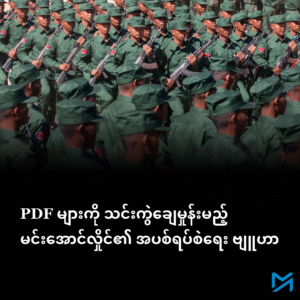
Still, the PDFs and NUG continue to depend on the EAOs, while the EAOs themselves remain essential to the revolution. This uprising cannot succeed without both—neither EAOs nor PDFs alone can achieve victory. The EAOs’ strength grew thanks to the anti-junta youth who joined them, while the PDFs’ improved combat skills came from EAO military training.
The young people who once passionately opposed dictatorship were extremely strong in 2021. But gradually, poor coordination, distrust toward leaders, and internal disunity weakened the movement. In some areas, manpower shortages became so serious that certain groups began recruiting even children.
In northern Shan State, a revolutionary group that had ruled like a “small kingdom” began retreating when TNLA withdrew from Mong Ko, and the M-PDF had to urgently recruit new fighters to defend it.
This shift reflects how some youths who once saw only “the army as the enemy” have changed their behavior—and how some began to lose trust in their own leaders.
It also exposes the self-interest and lack of loyalty of certain EAOs toward the PDFs under their influence.
– Mai Trazar (Chin Political)