U.S. Secretary of Defense Pete Hegseth has issued a stark warning regarding the growing possibility of a Chinese military offensive against Taiwan, describing the threat as “imminent” and urging nations across Asia to increase their defense cooperation and readiness in partnership with the United States.
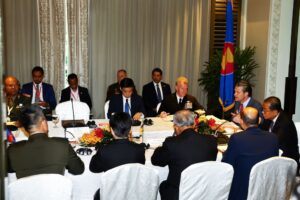
Delivering remarks at the Shangri-La Dialogue in Singapore—an esteemed annual security forum bringing together senior defense officials from across the Asia-Pacific—Secretary Hegseth underscored that while the United States does not seek confrontation with the People’s Republic of China, it remains committed to regional stability and will not permit coercion or intimidation of its allies and partners.
Taiwan, a democratically governed island that Beijing claims as its own territory, continues to be a flashpoint of regional concern. Although China has yet to respond officially to Secretary Hegseth’s statements, it has consistently refused to rule out the use of force to assert its claim over the island.
In his address, Secretary Hegseth characterized China as aspiring to a hegemonic role in the region, accusing Beijing of seeking to expand its influence by force, if necessary. He cited ongoing tensions in the South China Sea and warned that the Chinese military is actively preparing for a possible conflict, aimed at shifting the existing regional power structure.
- Claude’s answered my question about Trump’s US military had used its Anthropic’s Claude AI in Iran’s girl Primary school killing more than 160
- FB Admins should be called to ICC for the Israel Genocide hearing to answer for their bias against Palestines
- PDF Battalion Commander Accused of Sexual Assault and Religious Persecution of Muslim Female Volunteer
- Please give back our children at least a chance to dream as Myanmar
- A Satirical Essay on Nirvana
Referring to a timeline allegedly set by President Xi Jinping for the People’s Liberation Army to be capable of launching an invasion of Taiwan by 2027—a date frequently referenced by U.S. intelligence but never confirmed by Chinese authorities—Hegseth emphasized that China is “constructing the necessary military capabilities, training rigorously, and conducting exercises that suggest a high level of operational readiness.”
“To be unequivocal: any attempt by the Chinese Communist Party to take Taiwan by force would carry devastating consequences not only for the Indo-Pacific but for the global order,” Hegseth declared. “This is not a distant hypothetical. The threat is tangible—and it may be imminent. While we hope to avoid such a scenario, we must be prepared for its possibility.”
The Shangri-La Dialogue traditionally serves as a platform for strategic dialogue between the United States and China, allowing both powers to engage regional stakeholders. This year, however, Beijing sent only a minimal delegation and abruptly canceled a planned speech on the final day of the summit without explanation—an absence that may reflect the current chill in U.S.-China defense relations.